The bottle of Corona clanged against the engraved stone.
Once. I took a drink.
Twice. I took a drink.
Three times. I took a drink.
Four times. I emptied the bottle. Four toasts. Four drinks. I had nothing left to give.
Then, I broke.
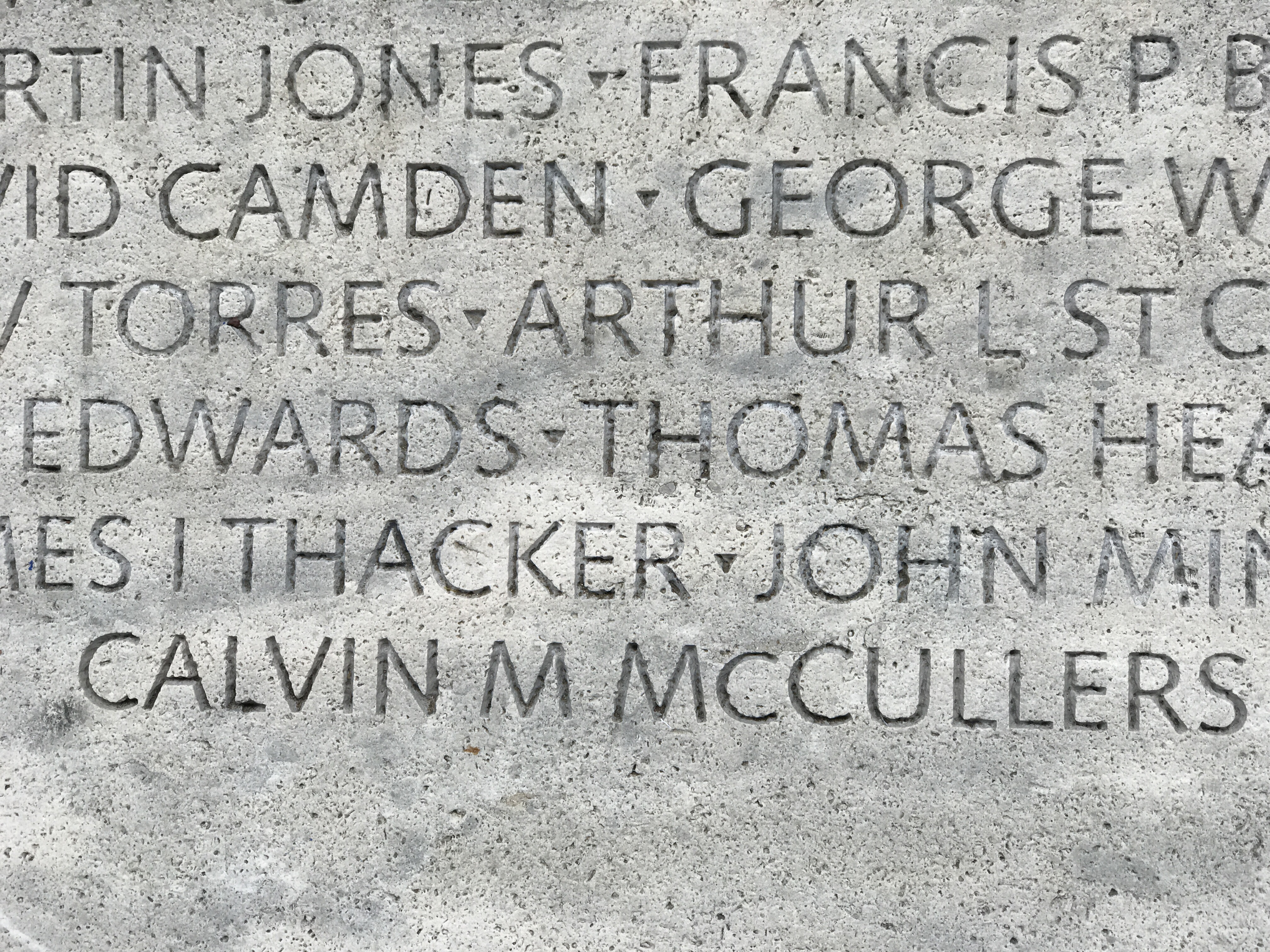
Mark’s name engraved on the National Memorial.
I sat slumped over the wall, my finger traced the carved name. It did little for my heart, but still my finger traced the letters – C-A-L-V-I-N.
First I was filled with anger, then sorrow.
At midnight the piper began his march; bag under his left arm, pipes in his hands, his fingers placed strategically over the air holes. With each sorrowful note, he took a step forward. It was a sad tune, his final tribute to the fallen.
I stood near the wall, surrounded by people I hardly knew. Some I had known for minutes, others for a couple days, but in that moment we became bound forever – held together by death – by the names now etched in stone.
I don’t understand death, I’m not sure if I ever will.
On Thursday, May 11, I sat in the gate area of Dallas Love Field Airport and waited to board my flight to Washington D.C. I had been a police officer for six months, and I had no idea that I was about to embark on one of the hardest journeys of my life in law enforcement.
I was headed to National Police Week as an escort officer for the family of fallen Southern Methodist University Police Officer Calvin “Mark” McCullers.
I knew Mark for a little over a year and a half before he was swept away in flood waters in the early morning hours of July 5. That morning the flooding was so bad and the current so strong that Mark’s body was washed into the Trinity River. It was 50 days before his body was recovered.
Mark and I worked the midnight shift together. While he patrolled the streets, I served as the dispatcher responsible for answering the phones and telling him where to respond.
We had a close relationship, highlighted by our love for boiled peanuts and passion for law enforcement. While Mark would tease me for being a reserve Marine, I would chide him about being a military police officer and not an infantry rifleman. It’s a bond that only fellow Marines could share.
When my patrol commander, Lt. Kelly, told me that I would be escorting Mark’s family to the national memorial, I saw it as my duty.
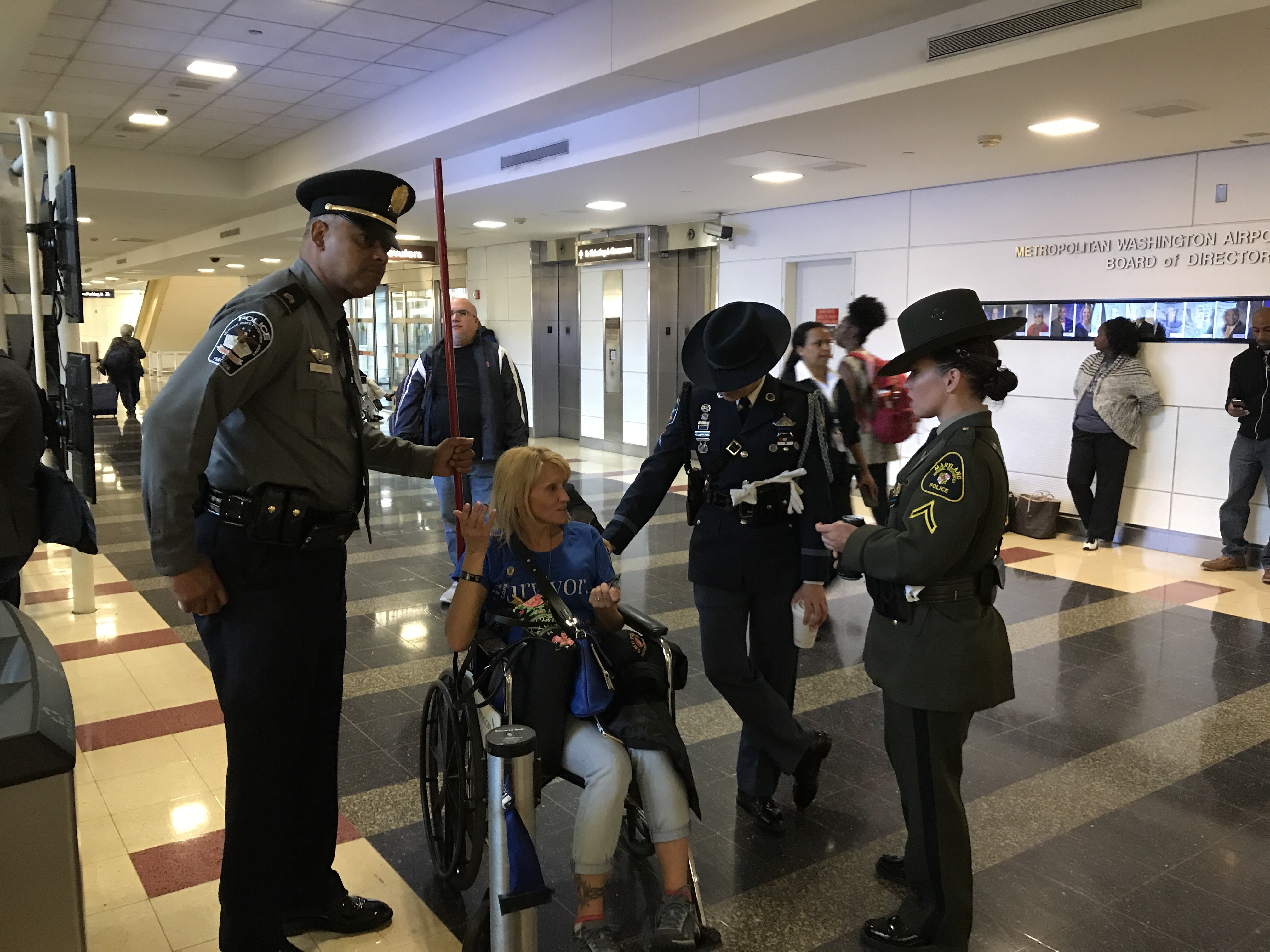
Mark’s wife Tiffany is greeted by law enforcement officers across the nation.
I landed at Reagan National Airport, greeted by a sea of law enforcement officers. Men and women in different colored uniforms stood all around the airport. Some wore white gloves, others had ascots around their necks, yet despite their varying appearance, all of them were there for the same reason.
When Mark’s family arrived we loaded a bus and headed to the host hotel. We were part of the first group of hundreds of surviving families from fallen law enforcement officers across the nation. I sat amazed as the city of Alexandria stood still for us; drivers got out of their cars with their phones, recording the dozens of motorcycles that escorted our bus.

Motor jocks move through to block traffic for survivors.
I breathed in deeply, thoughts running through my mind. This is what they deserve. This is how they should be honored.
More survivors were set to arrive on Thursday and even more on Friday.
On Saturday evening survivors loaded buses and traveled from the hotel to the National Mall. Again, the city stopped as the procession of charter buses and police motorcycles weaved through Washington D.C.
White plastic chairs lined the grass area between the Smithsonian museums, facing the national capitol. Law enforcement officers from across the nation lined the walkway as they waited for family members of the fallen to disembark the buses.

Red rose presented to survivors at the candlelight vigil.
As the survivors unloaded and began walking to their seats, each surviving woman – widow, sister, mother or daughter – was greeted by her own personal escort – a white gloved hand presenting them with a single red rose and offering an arm of support. A small, yet meaningful, gesture.
The vigil began with speech after speech. Each one highlighting the sacrifices of the slain officers and their surviving families. The hard part came with the name reading, as top law enforcement officers from across the country stood to read the names of the fallen from every state.
Across the audience, handfuls of people stood as names were called. These people were all that was left. Amid the reading echoed the whimper of a child, the cry of a mother, the sob of a wife, and the sigh of a father.
The real test of strength came on Monday. The National Law Enforcement Officers Memorial Ceremony was held on the lawn of the capitol, with the president and vice president in attendance.
For five days, my emotions didn’t matter. I was only there on duty. In moments that I felt weak, I stayed focused, asking myself what would Mark do?
That morning, I meticulously shaved my face and prepared my honor guard uniform for the memorial service.
For the service, I would escort Tiffany to the memorial wreath, where she would place a single red rose while I rendered a military salute.
From one Marine to another, a salute remains the highest form of respect.
That morning, we waited in the hotel meeting room to load buses to the capitol. I felt exhausted. While listening to the emotions of the family, I continued to feel things myself. I felt alone. I was a rookie officer staring into the eyes of the giant emotional monster that all police officers look to avoid – our feelings and the feelings of the survivors.
However, I knew my mission wasn’t over yet.
As I stood drinking liquid energy from an overpriced Redbull, I felt a small hand reach out and touch my leg. I looked down and the smiling face of a 2-year-old greeted me. Dressed properly, he wore a blue suit jacket, pin striped shirt and a pair of khaki pants.
“Hi buddy,” I said as I got down on my knees to be on his level.
“Hi,” he said quietly.
I stuck out my hand to give him five, but he reached past my hand and touched my badge. He touched it as though it was familiar to him, almost as if his daddy had worn one before he was gunned down.
In that moment, my heart heaved and sputtered, almost as if the flesh would stretch and tear as it slowly broke. I hugged him and he ran along, innocent and happy.
On that Monday, May 15, 2017, Washington DC stopped.
The procession moved slowly down Interstate 395, zigging and zagging along the highway like a long blue snake. Police motorcycles escorted us in the front and in the rear of the procession as we made our way past the Pentagon and over the Potomac river. Our destination, the heart of our nation.
I sat next to Tiffany on the bus ride. Her bodyguard.
She leaned over, grabbed my hand and looked at me with tears in her eyes.
“I don’t think I can do this,” she said.
“I know you can,” I said.
The buses arrived at the lawn of the capitol and I escorted Tiffany and her family to our seats. We were about twenty rows back from the memorial wreath that was placed just in front of President Donald Trump.
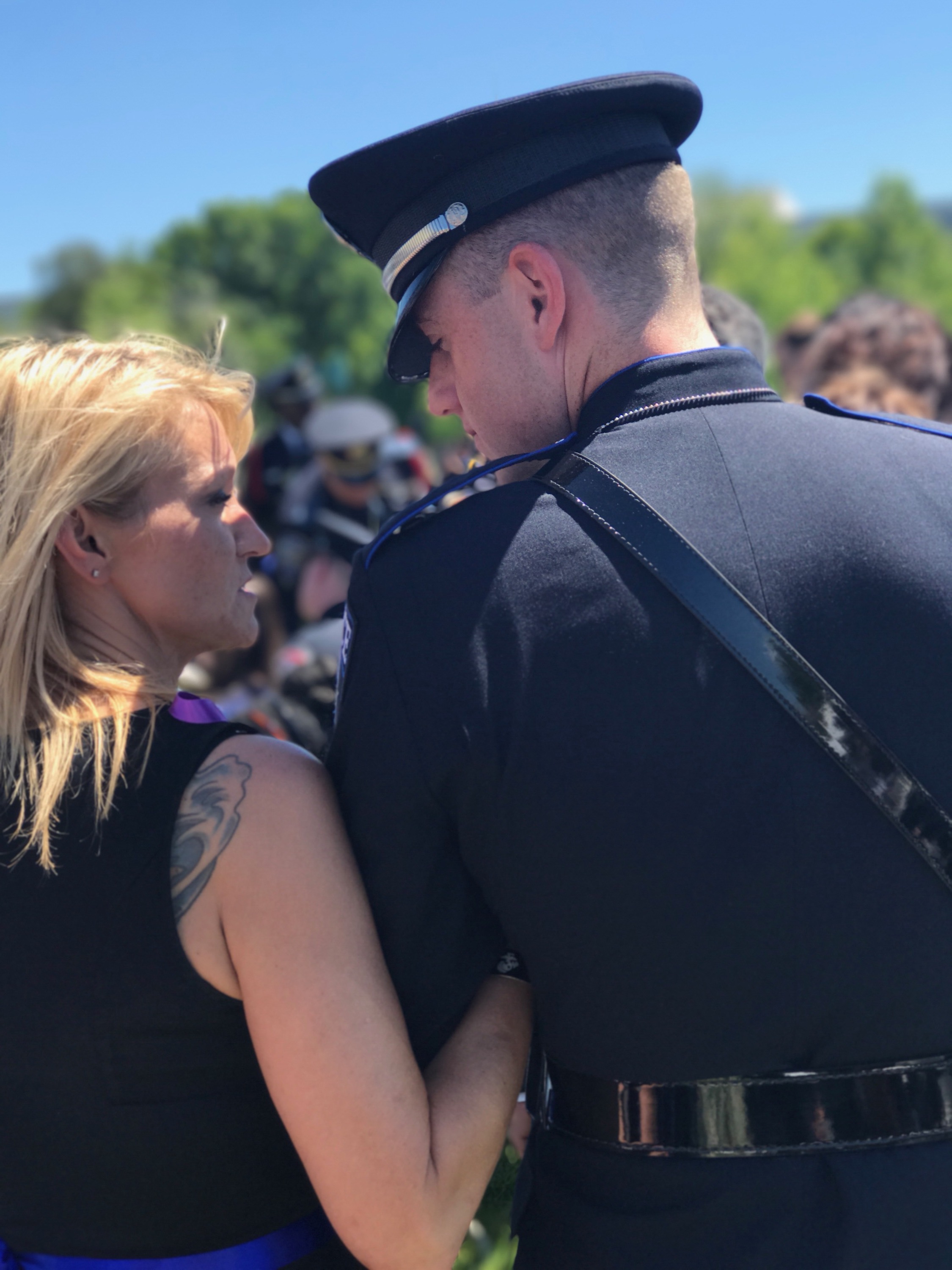
I escort Tiffany towards the Memorial Wreath.
Two hundred and thirty four names would be called – 234 red roses would be placed in the wreath.
As the minutes began to tick by, Tiffany, a diabetic, struggled as we waited for Mark’s name to be called. Her blood sugar began to drop, a combination of stress and heat. She didn’t want to leave without paying her final respects to Mark, but she was unsure if she would be able to walk to the wreath.
I helped her back to the first aid tent where she could cool off and try and get her blood sugar back up. While the medics tended to her, I stood outside, tracking the names on the program so I would know when to escort her back out.
“Texas,” the speaker said.
That was our signal. The speaker began reading off names of several other law enforcement officers in Texas who died in the line of duty.
“Amir Abdul-Khaliq,” he read.
“Lorne Ahrens.”
The name struck a cord. Officer Ahrens was one of the five Dallas officers shot on July 7, 2016, just two days after Mark went missing.
I escorted Tiffany to the center aisle. A police officer handed her a red rose. Mark and Tiffany’s “Brady-Bunch,” five of their six children, stood behind us.
Her right arm looped through my left arm as I stood at attention. We marched slowly forward. The large wreath loomed in front of us, outlined in white and blue flowers with a single star forming the center of the wreath – hundreds of red roses filled the center from the hundreds of other names called.
I stopped three paces from the wreath, stood at attention and slowly saluted.

I salute the wreath as Tiffany places Mark’s rose in the center.
Memories flooded my mind, taking me back to July 29, 2016, when I stood on SMU’s campus right outside of McFarlin Auditorium. On that day I saluted too, standing there wearing Marine Corps dress blues as the bugler played TAPS at the memorial service for Mark.
I refocused. Tiffany stepped forward and plunged the rose into the wreath.
No more memorials.
I breathed a sigh of relief.
I slowly cut my salute.
Tiffany stepped back, grabbed my arm and we turned to the left.
We were done.
The sound of the bagpipes faded into the darkness. I knelt down one last time, pressing my hand against the engraved stone.
“Semper Fidelis Devil Dog,” I said, “’til Valhalla.”
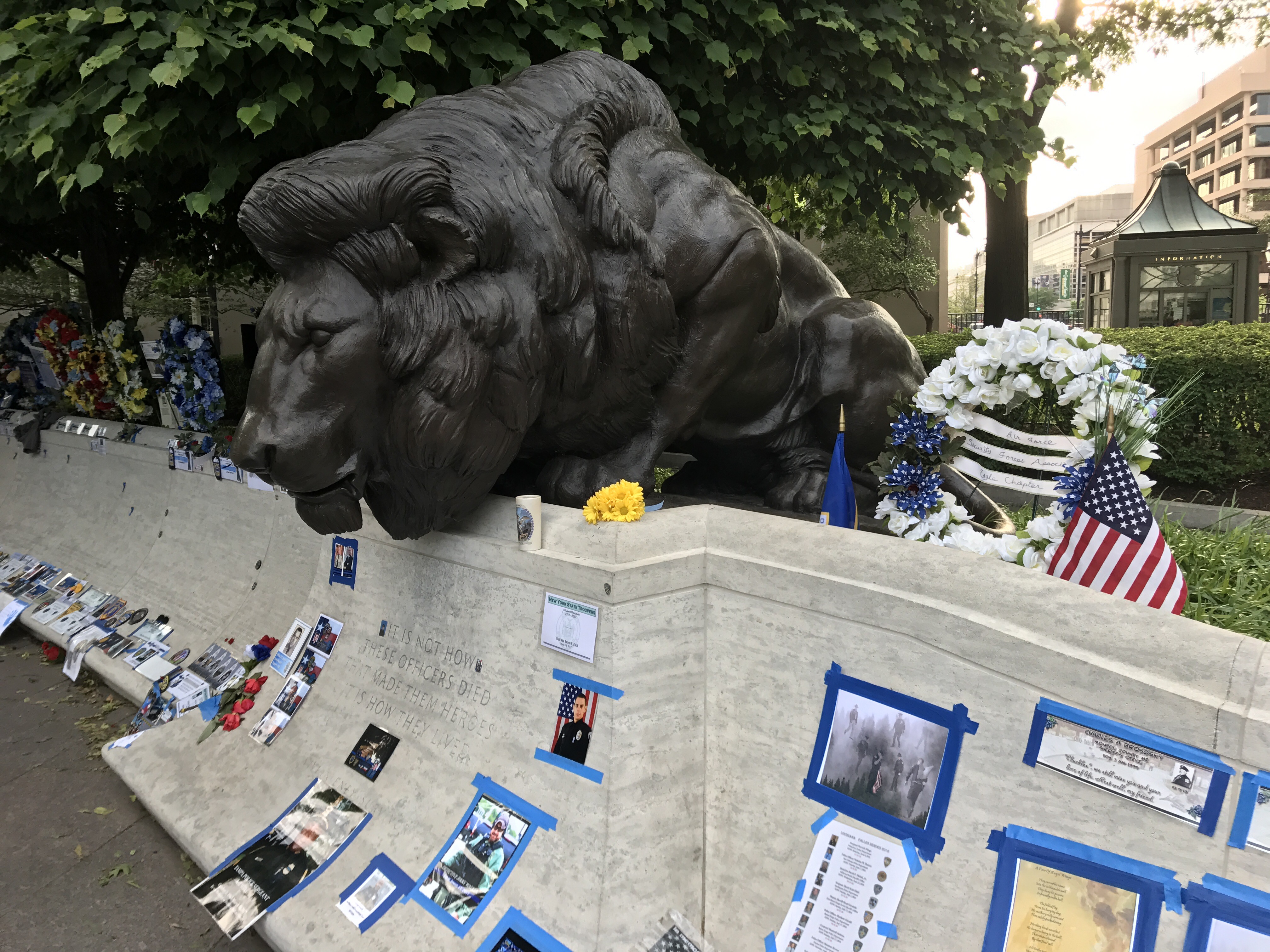
Lions protect the entrance to the National Memorial.
I slipped the empty Corona bottle into my back pocket. To this day, it sits on a shelf in my apartment. On bad days it is a solemn reminder that it could always be worse. On good days it is a reminder from Mark to be a better man. And on days when I’m tired from not sleeping and working 12 plus hours it is a tear starter, a reminder of some of the emotions I work so hard at hiding.
I left a part of myself in Washington D.C. that weekend.
 Jesse Carr